La transcripció fonètica
Les relacions entre els sons i les grafies
Cal distingir entre la representació ortogràfica de la llengua, la representació fonètica dels sons de la parla i la representació fonològica dels fonemes.
- Representació ortogràfica: grafemes, representats entre claus angulars < >.
- Representació fonètica: sons, representats entre claudàtors [ ].
- Representació fonològica: fonemes, representats entre barres obliqües / /.

lolPhonology. (2012, 11 d’abril). terminology [Imatge adjunta] [Actualització d’estat]. Facebook. https://www.facebook.com/photo.php?fbid=409530749075421
El grafema
La representació ortogràfica
ὀρθο ‘recte’, ‘correcte’
γραφία, de γράφειν ‘escriure’
L’ortografia estableix les regles d’associació entre grafemes (grafies) i sons.
Relacions entre grafemes i sons:
| un grafema | → | un so |
| un grafema | → | més d’un so |
| un grafema | → | cap so |
| un so | → | més d’un grafema |
| Un grafema → un so | <f> | → | [f] |
| Un grafema → dos sons | <s> | → | [s] [z] |
| Un grafema → tres sons | <e> | → | [e] [ɛ] [ə] |
| Dos grafemes → un so | <s> <ç> | → | [s] |
| Dos grafemes → un so | <ny> | → | [ɲ] |
| Un grafema → cap so | <h> | → | ∅ |
| Un grafema → un so | <ñ> | → | [ɲ] |
| Un grafema → dos sons | <c> | → | [k] [θ] |
| Dos grafemes → un so | <b> <v> | → | [b] |
| Dos grafemes → un so | <qu> | → | [k] |
| Un grafema → cap so | <h> | → | ∅ |
Les regles d’associació entre grafemes i sons són específiques per a cada llengua i presenten un grau de complexitat diferent:
- Ortografies transparents (shallow): tendència a la correspondència regular entre grafemes i sons.
- Ortografies opaques (deep): tendència a la correspondència irregular entre grafemes i sons.

Resultats de l’entrenament d’una xarxa neuronal artificial en la lectura (conversió de grafemes en fonemes) i en l’escriptura (conversió de fonemes en grafemes) de 17 llengües: àrab (ar), bretó (br), alemany (de), anglès (en), esperanto (eo), espanyol (es), finès (fi), francès (fr), francès Ortofasil (fro), italià (it), coreà (ko), neerlandès (nl), portuguès (pt), rus (ru), serbocroat (sh), turc (tr) i xinès (zh).
Marjou, X. (2021). OTEANN: Estimating the transparency of orthographies with an artificial neural network. A Proceedings of the Third Workshop on Computational Typology and Multilingual NLP (p. 1–9). ACL Anthology. https://doi.org/10.18653/v1/2021.sigtyp-1.1
<o> com en women: [ɪ]
<ti> com en nation: [ʃ]
Les normes ortogràfiques són convencions independents, des d’un punt de vista estrictament lingüístic, de les llengües a què s’apliquen.
|
(Font de la imatge: Verger, G. (s. d.). Juan Carlos Moreno Cabrera. A Gran Enciclopèdia Catalana. Consultat el 29 de setembre de 2026, a https://www.enciclopedia.cat/gran-enciclopedia-catalana/juan-carlos-moreno-cabrera)
|

May goostahreeah eerr ah oon pahrteedhoa day footbol
Es que vu vandé des anvlop e de yurnó?
Vindai oustaid saubraisse y pairiauxdicause?


Hi ha sistemes d’escriptura que s’han utilitzat per a representar gràficament diferents llengües.

|
(Font de la imatge: Feliu, L. (s. d.). Lluís Feliu [Perfil a Academia.edu]. Academia.edu. Consultat el 29 de setembre de 2026, a https://ub.academia.edu/LluisFeliu)
|


Els alfabets fonètics i la transcripció fonètica
Els alfabets fonètics
|
(Font de la imatge: Juana Gil Fernández. (s. d.). https://www.juanagilfernandez.com)
|

|
(Font de la imatge: Jornada d’homenatge al professor Ramon Cerdà. (2018). Alumni Universitat de Barcelona. https://www.alumni.ub.edu/jornada-homenatge-professor-ramon-cerda/)
|

Un alfabet fonètic és una eina per a la representació simbòlica de la parla.
El principi bàsic dels alfabets fonètics és que es dona una correspondència biunívoca entre un so i un símbol de transcripció.
Es fa servir un símbol de transcripció diferent per a cada so distintiu.
Un so distintiu no es pot representar mitjançant més d’un símbol de transcripció.
Si un mateix so es troba en diverses llengües, s’utilitza el mateix símbol.
La transcripció fonètica
|
(Font de la imatge: Juana Gil Fernández. (s. d.). https://www.juanagilfernandez.com)
|
|
(Font de la imatge: Jornada d’homenatge al professor Ramon Cerdà. (2018). Alumni Universitat de Barcelona. https://www.alumni.ub.edu/jornada-homenatge-professor-ramon-cerda/)
|
La transliteració
La transcripció fonètica no s’ha de confondre amb la transliteració.
Transliteració: representació dels caràcters d’un sistema d’escriptura mitjançant els caràcters d’un altre sistema d’escriptura.
Si la transliteració es realitza canviant els caràcters d’un sistema d’escriptura pels de l’alfabet llatí, es fa servir el terme ‘romanització’.
Per a la transliteració hi ha estàndards internacionals, estàndards propis de diverses especialitats i tradicions, i convencions específiques per a diverses llengües.
| Caràcters xinesos | 我是中國人 |
|---|---|
| Transliteració en pinyin | Wǒ shì Zhōngguó rén |
| Transcripció fonètica mitjançant l’Alfabet Fonètic Internacional | [wu̯ɔ˨˩ ʂɨ˥˩ tʂʊŋ˥˥ku̯ɔ˧˥ ʐən˧˥] |
Utilitat de la transcripció fonètica
pgswan. (2009, 20 de maig). Everyday IPA [Vídeo]. YouTube. https://www.youtube.com/watch?v=JO6XSCwUO8o
La transcripció fonètica es fa servir per a representar la pronúncia en:
- Diccionaris per a parlants natius.
- Diccionaris per a parlants no natius.
- Estudis de dialectologia i de sociolingüística que consideren variables fonètiques.
- Estudis fonètics sobre l’adquisició de la primera llengua.
- Estudis fonètics sobre l’adquisició de segones llengües i llengües estrangeres.
- Estudis sobre fonètica clínica.
- Qualsevol anàlisi de la llengua oral que requereixi representar la pronúncia dels parlants.
Dificultats i limitacions de la transcripció fonètica
Transcriure fonèticament una llengua desconeguda o transcriure realitzacions fonètiques poc habituals per al transcriptor pot plantejar dificultats:
- Tendència a prendre com a referència les categories i els contrasts fonològics propis de la primera llengua del transcriptor.
|
(Font de la imatge: Professor John Wells. (2014, 25 de setembre). University College London. https://web.archive.org/web/20250710040547/https://www.phon.ucl.ac.uk/home/wells/)
|

- Percepció categòrica de la parla en funció de la primera llengua del transcriptor: crea dificultats per a percebre distincions que no formen part del sistema fonològic (sistema de categories fonològiques) del transcriptor.
|
(Font de la imatge: Ball, M. J. (s. d.). Martin J. Ball [Perfil a Google Scholar]. Google Scholar. Consultat el 29 de setembre de 2026, a https://scholar.google.com/citations?user=LbfwhvoAAAAJ)
|
(Font de la imatge: Howard, S. (s. d.). Profile [Perfil a ResearchGate]. ResearchGate. Consultat el 29 de setembre de 2026, a https://www.researchgate.net/profile/Sara-Howard-2)
|
|
(Font de la imatge: Müller, N. (s. d.). Profile [Perfil a ResearchGate]. ResearchGate. Consultat el 29 de setembre de 2026, a https://www.researchgate.net/profile/Nicole-Mueller-2)
|
 Angela Granese (Font de la imatge: Angela Granese, ’06, accepted into Univ. of Louisiana Ph.D Program. (s. d.). University of South Florida Alumni Association) |


La percepció categòrica de la parla
La transcripció implica una interpretació de les dades per part de l’investigador.
|
(Font de la imatge: Professor John Wells. (2014, 25 de setembre). University College London. https://web.archive.org/web/20250710040547/https://www.phon.ucl.ac.uk/home/wells/)
|
els nens [əls̬ˈnɛns]: en la transcripció s’indica que s’ha donat un procés de sonorització d’una fricativa alveolar sorda per la influència de la consonant sonora següent
En ambdós casos la realització fonètica és una consonant fricativa alveolar sonora
mismo [ˈmis̬mo]: en la transcripció s’indica que s’ha donat un procés de sonorització d’una fricativa alveolar sorda per la influència de la consonant sonora següent
En ambdós casos la realització fonètica és una consonant fricativa alveolar sonora
Dos sons que en llengües diferents es poden representar amb el mateix símbol no necessàriament tenen una manifestació fonètica idèntica.
|
(Font de la imatge: Professor John Wells. (2014, 25 de setembre). University College London. https://web.archive.org/web/20250710040547/https://www.phon.ucl.ac.uk/home/wells/)
|
La transcripció de l’entonació planteja dificultats degudes al caràcter continu de la corba melòdica i a la necessitat de segmentar-la en unitats lingüísticament significatives.
La lectura d’una transcripció fonètica no garanteix necessàriament una pronúncia perfectament nativa d’una llengua que es desconeix.
Tipus de transcripció fonètica
Tradicionalment es distingeixen dos tipus de transcripció:
- Transcripció sistemàtica: reflecteix l’estructura fonològica de la llengua.
- Transcripció impressionista: recull tots els detalls de la realització fonètica.
The first type of transcription is called impressionistic, and the second systematic» (p. 127–128).
Segons el grau de detall, la transcripció sistemàtica pot ser ampla o estreta; la transcripció impressionista és sempre estreta.
Transcripció fonètica ampla
És una transcripció sistemàtica en la qual es transcriuen principalment els elements distintius (fonemes) de la llengua; per això també s’anomena, a vegades, ‘transcripció fonològica’.
En alguns casos es tendeix a utilitzar, per simplicitat, els símbols que coincideixen amb lletres de l’alfabet llatí.

Transcripció ampla d’El viento norte y el sol en espanyol de Buenos Aires.
Publicat originalment a Jones, D. i Dahl, I. (1944). Fundamentos de escritura fonética según el sistema de la Asociación Fonética Internacional. University College London, Department of Phonetics. Reproduït a Martínez Celdrán, E., Fernández Planas, A. M. i Carrera, J. (2003). Castilian Spanish. Journal of the International Phonetic Association, 33(2), 255–259. https://doi.org/10.1017/S0025100303001373
Transcripció fonètica estreta
Transcripció impressionista
Transcripció que recull tots els detalls possibles de la realització fonètica.
La transcripció impressionista es fa servir:
- En les etapes inicials del treball de camp, quan no es disposa d’informació sobre l’estructura fonològica de la llengua o el dialecte estudiats.
- En la transcripció de la parla amb alteracions o de la parla infantil.
Transcripció al·lofònica
Transcripció estreta sistemàtica: es transcriuen les realitzacions al·lofòniques dels fonemes.
En certs casos les realitzacions al·lofòniques que es poden predir de manera regular no es recullen en la transcripció, sinó que s’indiquen en l’explicació de les convencions que s’han seguit en la transcripció.

Transcripció semiestreta d’El viento norte y el sol en espanyol peninsular.
Martínez Celdrán, E., Fernández Planas, A. M. i Carrera, J. (2003). Castilian Spanish. Journal of the International Phonetic Association, 33(2), 255–259. https://doi.org/10.1017/S0025100303001373
Representació fonètica i representació fonològica
L’Alfabet Fonètic Internacional

IPA, International Phonetic Alphabet.
API, Alphabet Phonétique International.
AFI, Alfabeto Fonético Internacional – Alfabet Fonètic Internacional.
Desenvolupament històric de l’Alfabet Fonètic Internacional
1882: Inicis del moviment de renovació de l’ensenyament de les llengües modernes a Europa.
1886: Fundació de The Phonetic Teachers’ Association (Dhi Fonètik Tîtcerz’ Asóciécon) i publicació de la revista The Phonetic Teacher (Dhi Fonètik Tîtcer).
1888: Primera versió de l’alfabet fonètic que donarà lloc a l’Alfabet Fonètic Internacional.
1889: The Phonetic Teachers’ Association canvia el nom a Association Phonétique de Professeurs de Langues Vivantes. La revista The Phonetic Teacher passa a denominar-se Le Maître Phonétique (lə mɛːtrə fɔnetik).
1897: L’Association Phonétique de Professeurs de Langues Vivantes es converteix en l’Association Phonétique Internationale (API) – International Phonetic Association (IPA).
 |
 |
| Paul Passy (1859–1940)
(Font de la imatge: Smith, R. (2010, 13 de març). Paul Passy (1859–1940). Warwick ELT Archive: Hall of Fame. https://warwick.ac.uk/fac/soc/al/research/collections/elt_archive/halloffame/passy/)
|
Otto Jespersen (1860–1943)
(Font de la imatge: Smith, R. (2010, 13 de març). Otto Jespersen (1860–1943). Warwick ELT Archive: Hall of Fame. https://warwick.ac.uk/fac/soc/al/research/collections/elt_archive/halloffame/jespersen/)
|
 |
 |
| Henry Sweet (1845–1912)
(Font de la imatge: Forshaw, W. [ca. 1890]. Henry Sweet [Fotografia]. National Portrait Gallery, London, England. https://www.npg.org.uk/collections/search/portrait/mw248211/Henry-Sweet)
|
Wilhelm Viëtor (1850–1918)
(Font de la imatge: Smith, R. (2010, 13 de març). Wilhelm Viëtor (1850–1918). Warwick ELT Archive: Hall of Fame. https://warwick.ac.uk/fac/soc/al/research/collections/elt_archive/halloffame/vietor/)
|
1900: Publicació de l’Exposé des principes de l’Association Phonétique Internationale.
1949: Publicació de The Principles of the International Phonetic Association.
International Phonetic Association. (2010). The Principles of the International Phonetic Association (1949). Journal of the International Phonetic Association, 40(3), 299–358. https://doi.org/10.1017/S0025100311000089
1971: Le Maître Phonétique canvia el títol a Journal of the International Phonetic Association (JIPA).
1989: Congrés a Kiel (Alemanya) per a actualitzar i modificar l’Alfabet Fonètic Internacional.
International Phonetic Association. (1989). Report on the 1989 Kiel Convention. Journal of the International Phonetic Association, 19(2), 67–80. https://doi.org/10.1017/S0025100300003868
1999: Publicació del Handbook of the International Phonetic Association.
International Phonetic Association. (1999). Handbook of the International Phonetic Association: A guide to the use of the International Phonetic Alphabet. Cambridge University Press. https://doi.org/10.1017/9780511807954
2005: Última revisió de l’Alfabet Fonètic Internacional.
International Phonetic Association. (2026). The International Phonetic Alphabet and the IPA Chart [IPA Chart revised to 2015/2005]. International Phonetic Association. https://www.internationalphoneticassociation.org/content/ipa-chart
2015: Modificacions tipogràfiques per a presentar l’alfabet en tres tipus de fonts: IPA Kiel, DejaVu Sans i Doulos SIL. Posteriorment s’afegeix una versió en TeX TIPA Roman.
International Phonetic Association. (2026). The IPA Chart and sub-charts in four fonts. International Phonetic Association. https://www.internationalphoneticassociation.org/IPAcharts/IPA_charts_E/IPA_charts_E.html
2018 –: Desenvolupament de versions de l’Alfabet Fonètic Internacional amb traduccions a diverses llengües (entre les quals hi ha el català i el castellà) de la terminologia utilitzada en la descripció fonètica. No es consideraran versions oficials fins que no siguin aprovades per l’Associació Fonètica Internacional.
International Phonetic Association. (s. d.). IPA charts in other languages. https://www.internationalphoneticassociation.org/IPAcharts/IPA_chart_trans/IPA_charts_T.html
2025 – A partir del 2025 cada any es publica una versió de l’Alfabet Fonètic Internacional amb una nota al peu del quadre de símbols que indica la data de la darrera revisió (IPA chart revised to 2015/2005 en la versió actual) i amb la data dels drets d’autor actualitzada cada any, juntament amb els símbols corresponents a la llicència, a la part superior dreta del quadre.
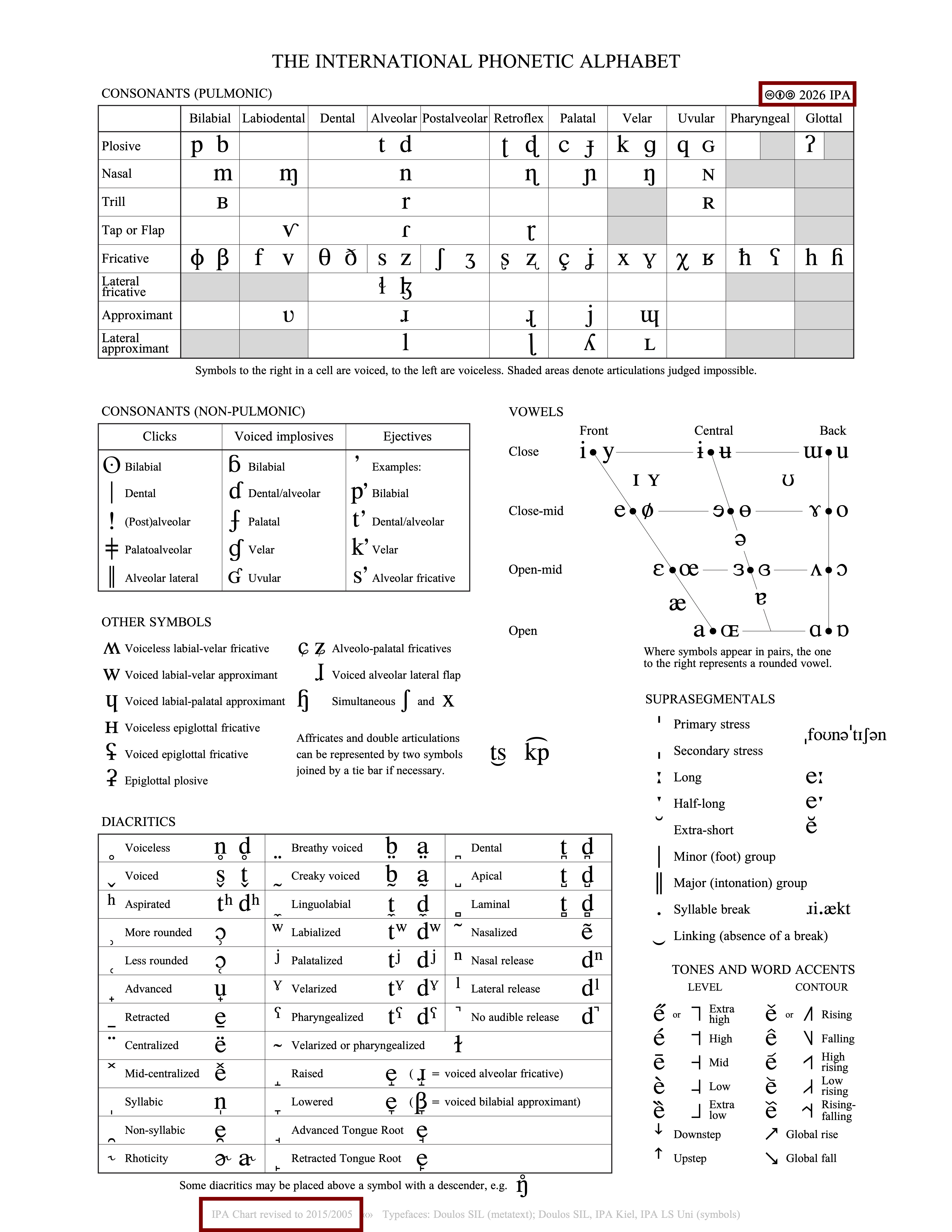
Alfabet Fonètic Internacional amb data de drets d’autor del 2026.
International Phonetic Association. (2026). The International Phonetic Alphabet and the IPA Chart [IPA Chart revised to 2015/2005]. International Phonetic Association. https://www.internationalphoneticassociation.org/content/ipa-chart
Principis de l’Alfabet Fonètic Internacional
L’Alfabet Fonètic Internacional s’orienta principalment a donar una resposta a necessitats lingüístiques pràctiques:
- Representar l’estructura fonètica i fonològica de les llengües.
- Ajudar en l’adquisició de la pronúncia en llengües estrangeres.
- Desenvolupar escriptures «llatines» per a llengües en què es fan servir altres sistemes d’escriptura o per a llengües sense un sistema de representació escrita.
L’Alfabet Fonètic Internacional pretén ser un conjunt de símbols mitjançant els quals es puguin representar els sons possibles en les llengües del món.
Els sons representats en la transcripció són principalment els que serveixen per a distingir significats de paraules en les llengües, és a dir, els sons distintius.
L’Alfabet Fonètic Internacional es revisa si apareixen noves dades sobre sons amb valor contrastiu en les llengües del món.
L’any 2005 l’Associació Fonètica Internacional va aprovar incloure un nou símbol per a representar un so bategant labiodental, a proposta de Kenneth S. Olson, després de documentar que aquesta consonant forma part del sistema fonològic de diverses llengües parlades, sobretot, a l’Àfrica.
Símbols emprats a l’Alfabet Fonètic Internacional
International Phonetic Association. (2026). The International Phonetic Alphabet and the IPA Chart [IPA Chart revised to 2015/2005]. International Phonetic Association. https://www.internationalphoneticassociation.org/content/ipa-chart
- Consonants pulmonars
- Consonants no pulmonars
- Vocals
- Altres símbols
- Diacrítics
- Elements suprasegmentals
- Tons i accents tonals de mot
Consonants pulmonars
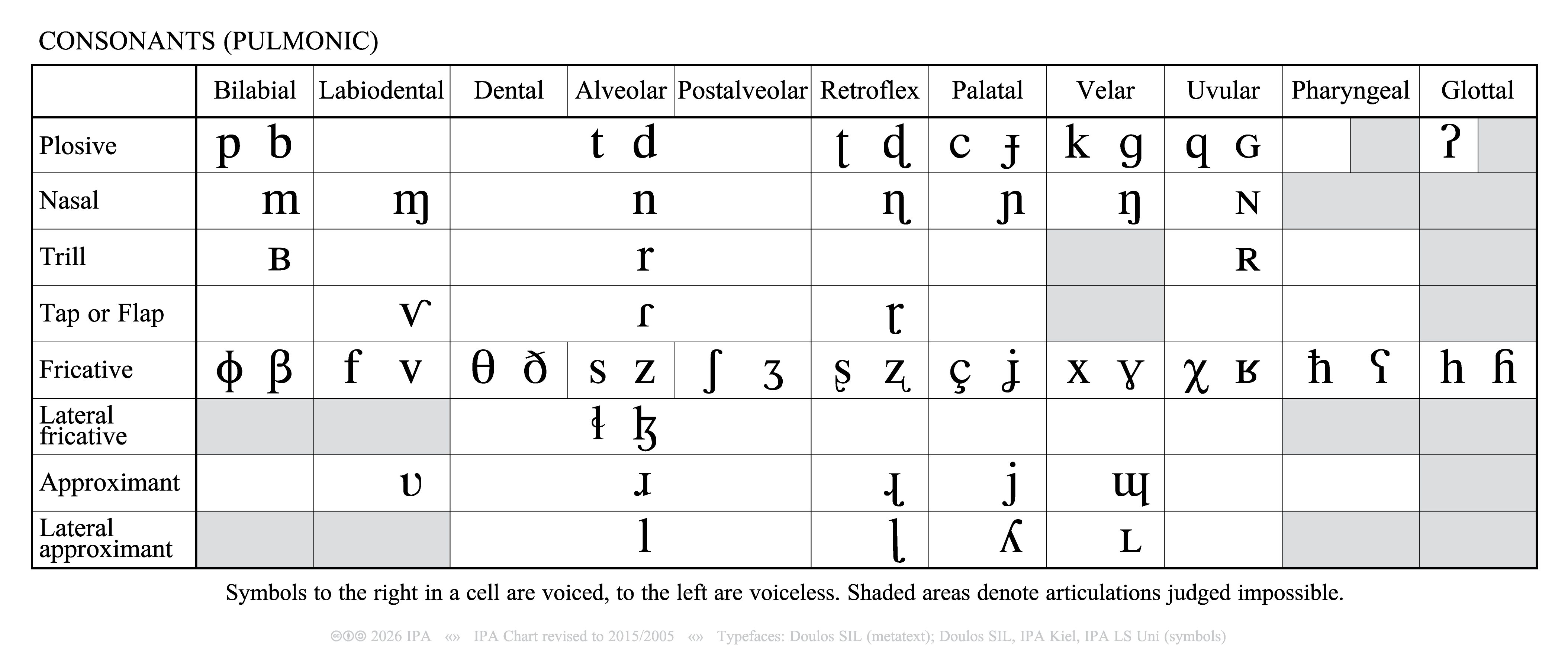
Consonants pulmonars.
International Phonetic Association. (2026). The International Phonetic Alphabet and the IPA Chart [IPA Chart revised to 2015/2005]. International Phonetic Association. https://www.internationalphoneticassociation.org/content/ipa-chart
La classificació articulatòria dels sons de la parla: mode d’articulació
La classificació articulatòria dels sons de la parla: zona d’articulació
Consonants no pulmonars
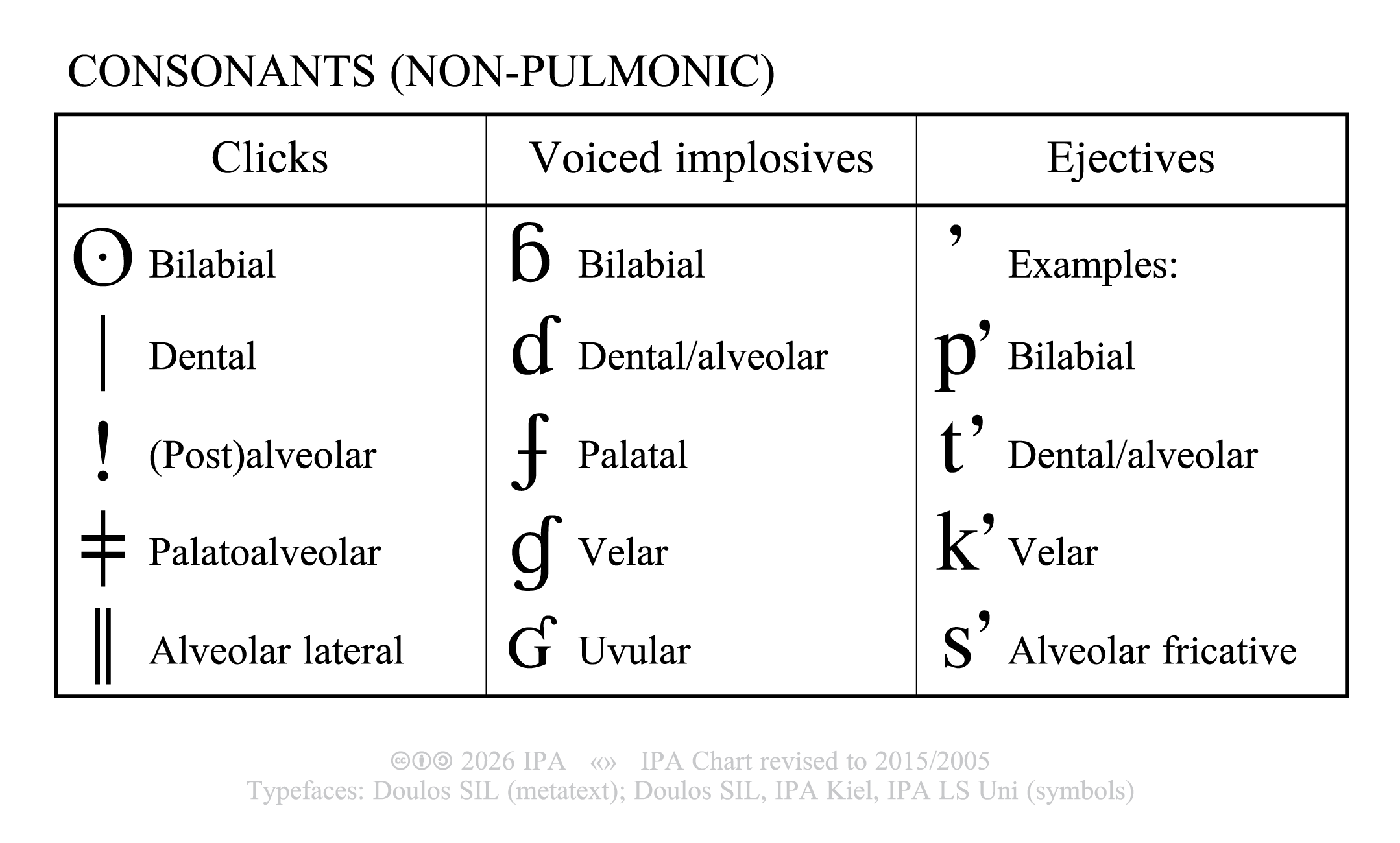
Consonants no pulmonars.
International Phonetic Association. (2026). The International Phonetic Alphabet and the IPA Chart [IPA Chart revised to 2015/2005]. International Phonetic Association. https://www.internationalphoneticassociation.org/content/ipa-chart
La classificació articulatòria dels sons de la parla: consonants no pulmonars
Vocals
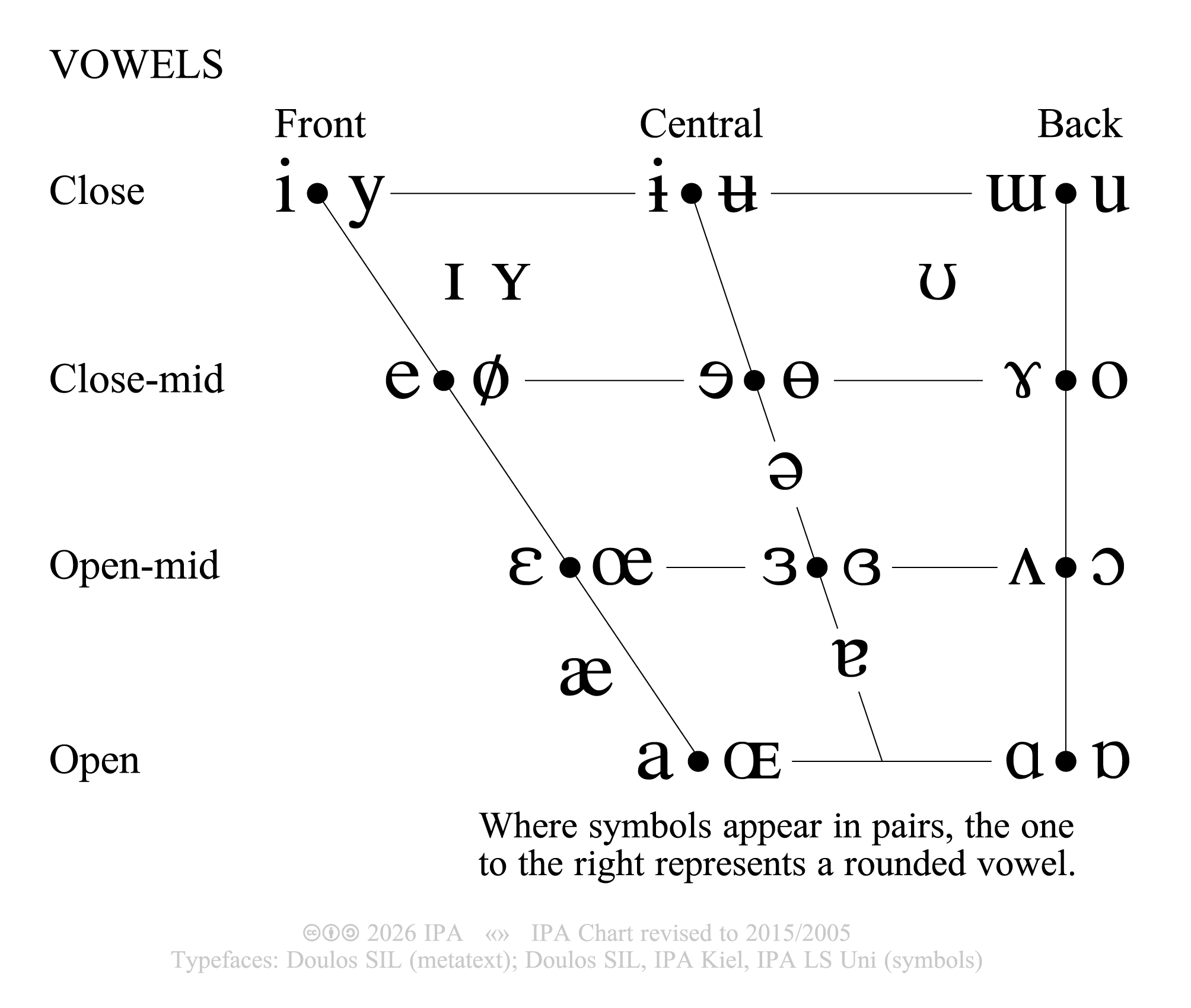
Vocals.
International Phonetic Association. (2026). The International Phonetic Alphabet and the IPA Chart [IPA Chart revised to 2015/2005]. International Phonetic Association. https://www.internationalphoneticassociation.org/content/ipa-chart
La classificació articulatòria dels sons de la parla: vocals
Altres símbols
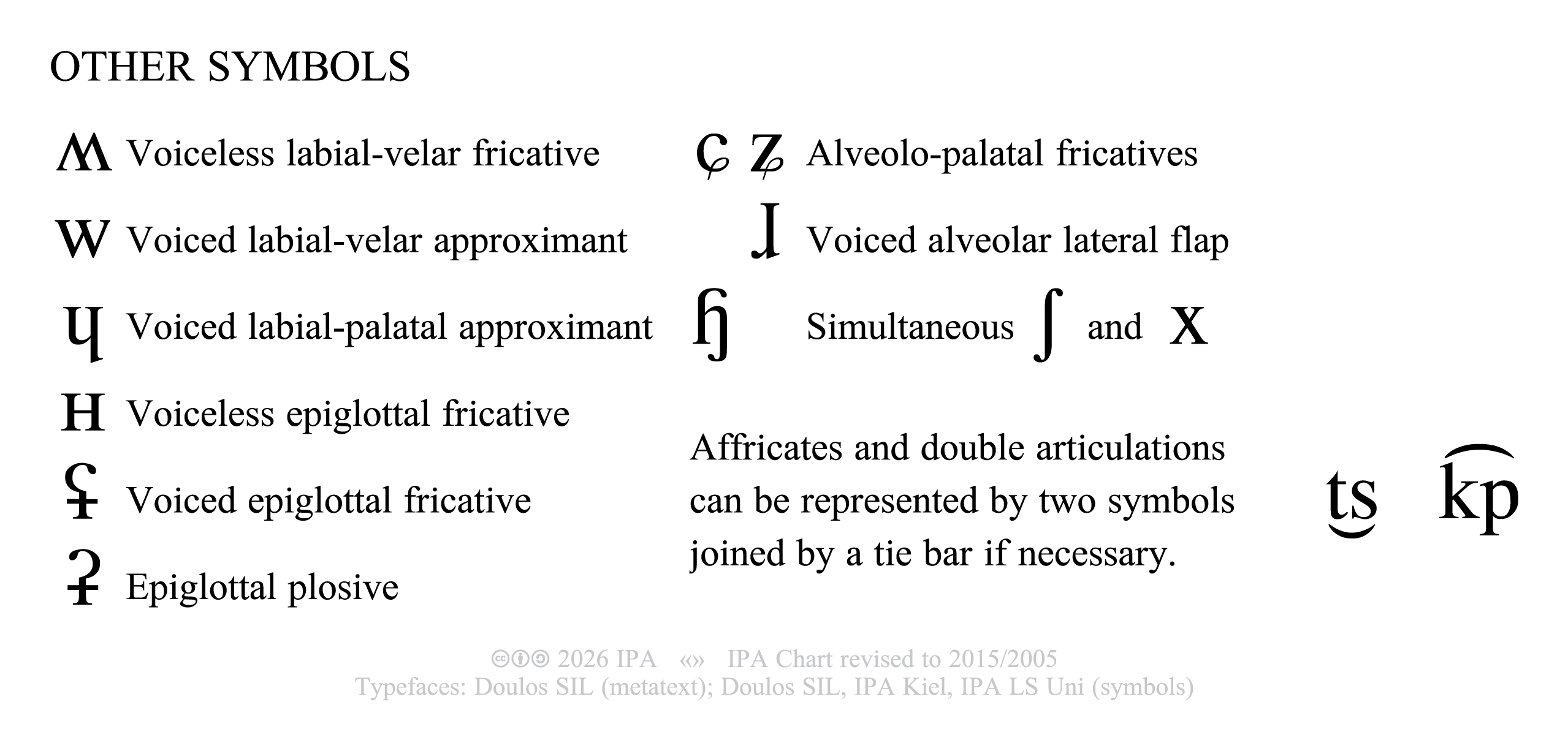
Altres símbols.
International Phonetic Association. (2026). The International Phonetic Alphabet and the IPA Chart [IPA Chart revised to 2015/2005]. International Phonetic Association. https://www.internationalphoneticassociation.org/content/ipa-chart
Diacrítics
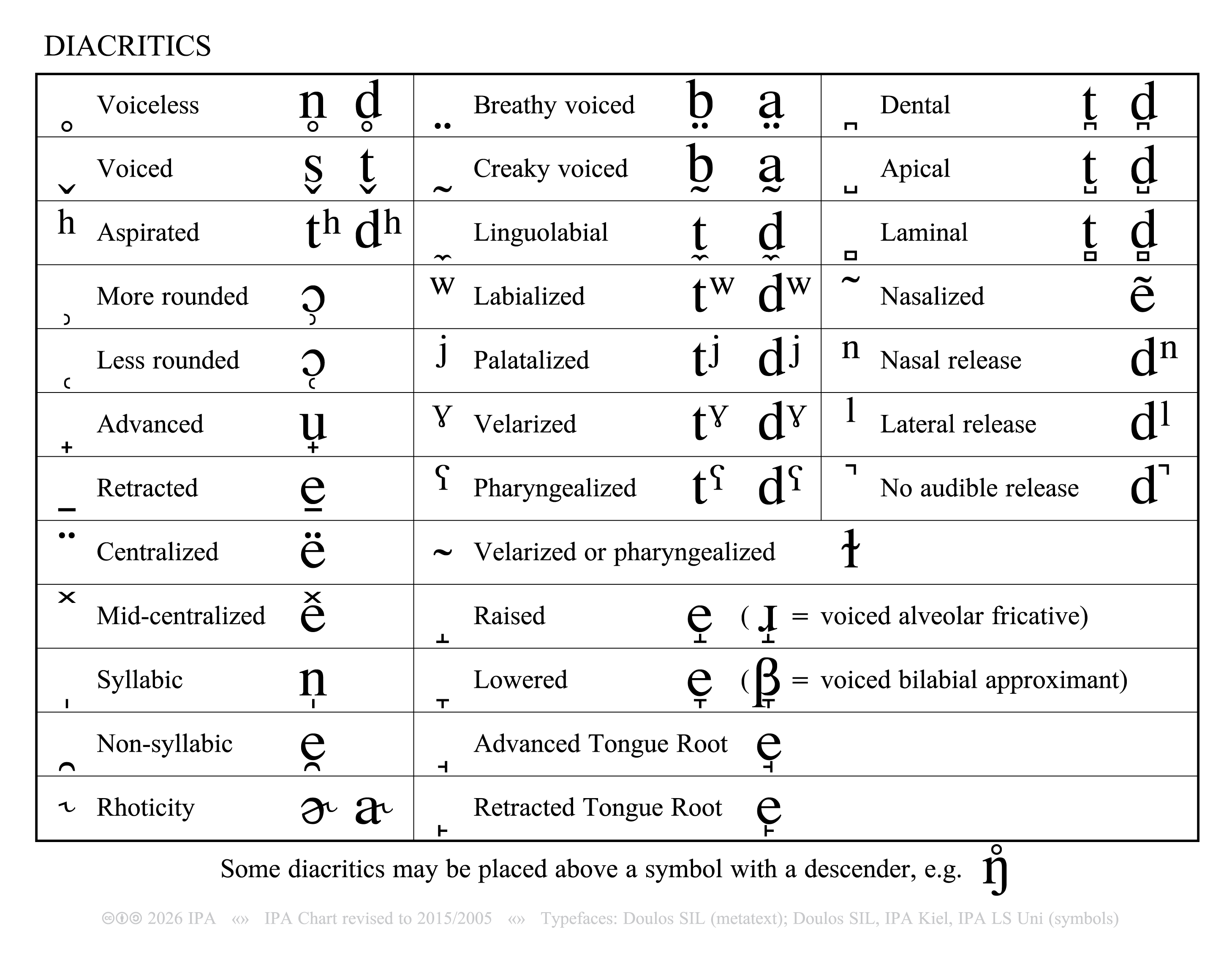
Diacrítics.
International Phonetic Association. (2026). The International Phonetic Alphabet and the IPA Chart [IPA Chart revised to 2015/2005]. International Phonetic Association. https://www.internationalphoneticassociation.org/content/ipa-chart
Elements suprasegmentals
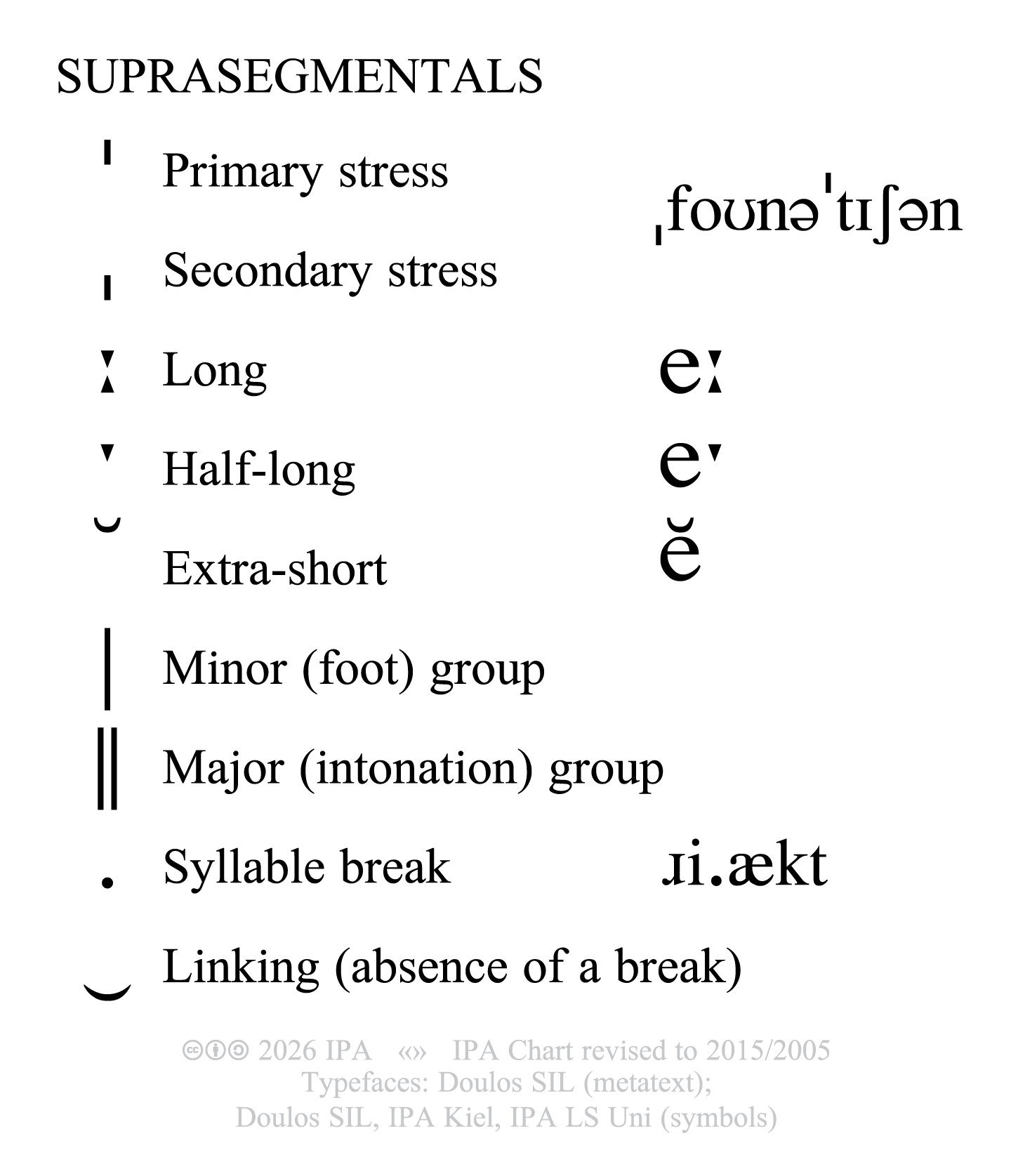
Elements suprasegmentals.
International Phonetic Association. (2026). The International Phonetic Alphabet and the IPA Chart [IPA Chart revised to 2015/2005]. International Phonetic Association. https://www.internationalphoneticassociation.org/content/ipa-chart
Tons i accents tonals de mot
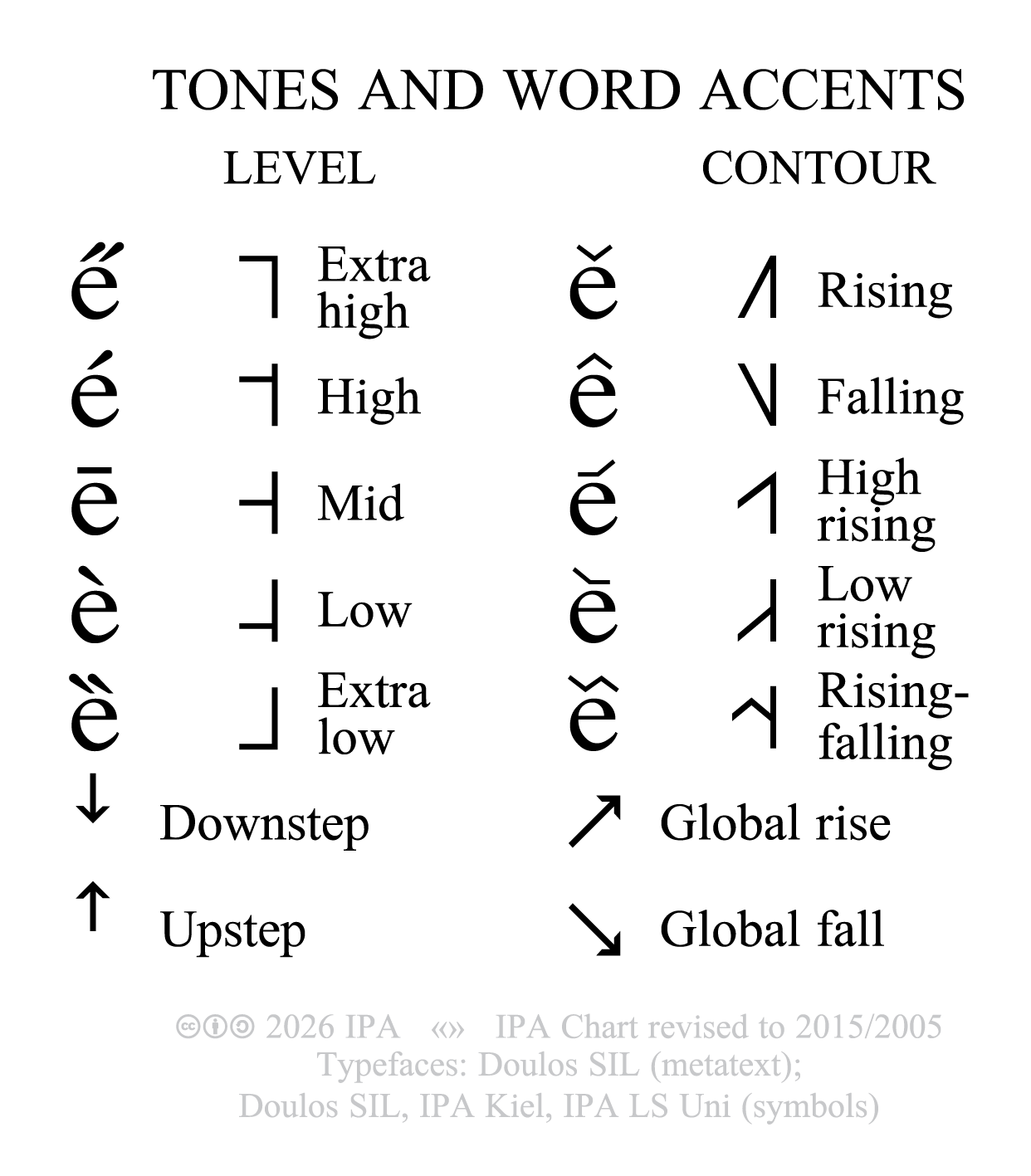
Tons i accents tonals de mot.
International Phonetic Association. (2026). The International Phonetic Alphabet and the IPA Chart [IPA Chart revised to 2015/2005]. International Phonetic Association. https://www.internationalphoneticassociation.org/content/ipa-chart
L’alfabet fonètic de la Revista de Filología Española
Sistema de transcripció fonètica proposat per Tomás Navarro Tomás el 1915 per a la Revista de Filología Española.
Emprat únicament en treballs tradicionals de l’àmbit hispànic.
|
(Font de la imatge: Tomás Navarro Tomás (1884–1979). (1988). Excelentísima Diputación de Albacete; Excelentísimo Ayuntamiento de La Roda.)
|


Alfabet fonètic de la Revista de Filología Española.
Revista de Filología Española. (1915). Alfabeto fonético. Revista de Filología Española, 2(4), 374–376. https://archive.org/details/revistadefilolog02centuoft
Sistema adaptat al català per Antoni M. Badia i Margarit el 1951.
|
(Font de la imatge: Carbonell, J. i Ferrer, I. (s. d.). Antoni Maria Badia i Margarit. A Gran Enciclopèdia Catalana. Consultat el 29 de setembre de 2026, a https://www.enciclopedia.cat/gran-enciclopedia-catalana/antoni-maria-badia-i-margarit)
|


Adaptació al català de l’alfabet fonètic de la Revista de Filología Española.
Badia i Margarit, A. M. (1984). Gramàtica històrica catalana (2a ed.). Tres i Quatre.
Alfabets fonètics per a usos computacionals